Natural Face Care Products vs. the Chemical Myth: The Truth About Chemical-Free Face Serums
Your serum is supposed to be the hardest-working product in your routine. The one that goes deepest, stays longest, and delivers the most concentrated results. So it’s worth asking if you actually know what’s in it?
For most of us, the answer is uncomfortable. We have spent years reaching for natural face care products that promise glowing skin, only to flip the bottle and find a paragraph of unpronounceable chemical names. And buried in that list are sulphates, synthetic fragrances, parabens, and stabilisers whose primary job is to extend shelf life, not improve your skin. The shift toward a chemical-free face serum isn’t a wellness fad. It’s a logical response to finally reading what we’ve been putting on our faces.
So let’s talk about what’s actually in your serum, and what should be.
What “Chemical-Free” Really Means
First, a small but important clarification. Technically, everything is a chemical; water is a chemical. What the term chemical-free actually signals is the absence of synthetically derived, lab-manufactured compounds: artificial preservatives, petroleum-derived emollients, PEGs, silicones, and colourants that serve cosmetic rather than skin-health purposes.
A genuinely clean serum is built from cold-pressed oils, plant extracts, and botanical actives, ingredients that exist in nature and have been used on skin for centuries. Apricot kernel oil. Pomegranate seed oil. Rosehip. Jojoba. Sea buckthorn. These aren’t exotic additions to pad an ingredient list. They are the ingredient list.
When your serum is made this way, your skin isn’t just being coated, it’s being fed.
Why Indian Skin Needs a Different Conversation
Most serums on Indian shelves were formulated for western skin, in western climates, addressing western concerns. They weren’t designed with Hyderabad summers, Chennai humidity, or the specific kind of tan and pigmentation that comes from melanin-rich Indian skin in mind.
The result? Many Indian women experience what looks like a reaction to “sensitive skin”, but is actually their skin rejecting formulations it was never meant to receive. Breakouts after a supposedly hydrating serum. Increased oiliness from a product marketed as balancing. Irritation from a serum that promises calm.
A plant-based skincare routine built around Indian botanicals – vetiver, goat milk, rosemary, blue pea flower, ashwagandha, works in sync with how Indian skin actually behaves. Not against it. It’s the philosophy that brands like Bask in Nature have been quietly championing, formulating specifically around Indian skin realities, not borrowed western templates.
The Small-Batch Difference
There’s another layer to this conversation that rarely gets discussed: freshness.
Commercial serums are manufactured in large batches and spend months in warehouses and on shelves before they reach you. To survive that journey, they need preservatives and stabilisers. Many of the synthetic ingredients you’re trying to avoid are there not to benefit your skin, but to protect the product’s shelf life.
Handcrafted serums made in small batches don’t have this problem. They’re formulated closer to when you receive them, which means the active botanicals are at peak potency. The rosehip oil hasn’t oxidised. The plant extracts haven’t degraded. What reaches your skin is the real thing, not a stabilised approximation of it.
This is the quiet promise of genuinely handmade skincare: every drop does what it’s supposed to.
What to Look for in a Clean Face Serum
When you’re evaluating whether a serum is worth your skin’s trust, here’s a simple filter:
Can you picture every ingredient growing somewhere?
Virgin coconut oil – yes.
Sweet almond oil – yes.
PEG-100 stearate – no.
Phenoxyethanol – no.
That’s not to say every synthetic ingredient is harmful, but if the majority of your serum’s formula can’t pass that test, it’s worth questioning what you’re actually paying for.
Also look for: no artificial fragrance (one of the most common hidden irritants), no mineral oil or petroleum derivatives, and transparency about sourcing. A brand that tells you why each ingredient is in the formula, not just that it’s there, is a brand that has nothing to hide.
Your Skin Deserves the Full Story
Switching to a natural face care products routine doesn’t require throwing everything out at once. Start with your serum. It’s the product that penetrates deepest and stays on your skin the longest, which means it has the greatest potential to either nourish or burden it.
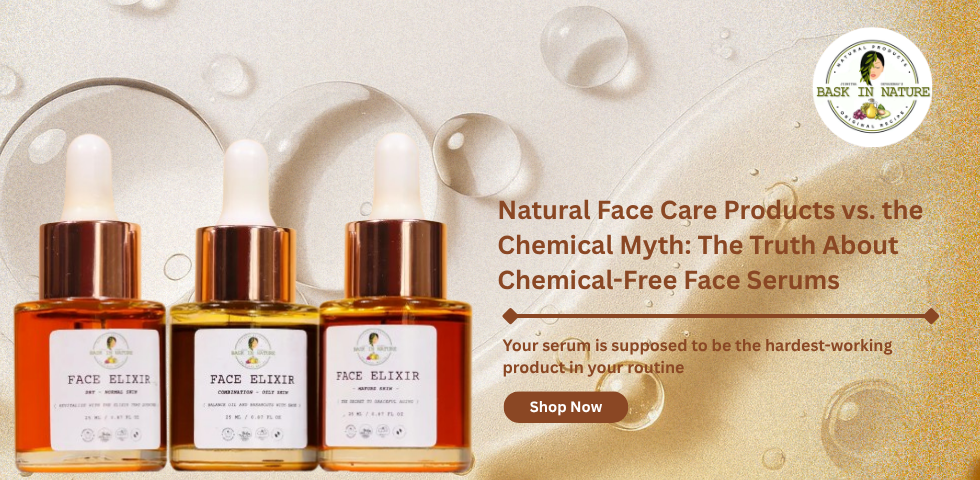
When you move to a plant-based skincare routine grounded in pure botanicals, the changes are gradual but real. Skin that feels less reactive. Texture that smooths out over weeks, not just hours. A glow that doesn’t wash off. Bask in Nature’s Face Elixir, a blend of apricot, pomegranate, avocado, and sea buckthorn oils, is a good example of what this looks like in practice: a serum where every single ingredient has a reason to be there.
That’s not marketing. That’s what happens when your skin finally gets ingredients it recognise